
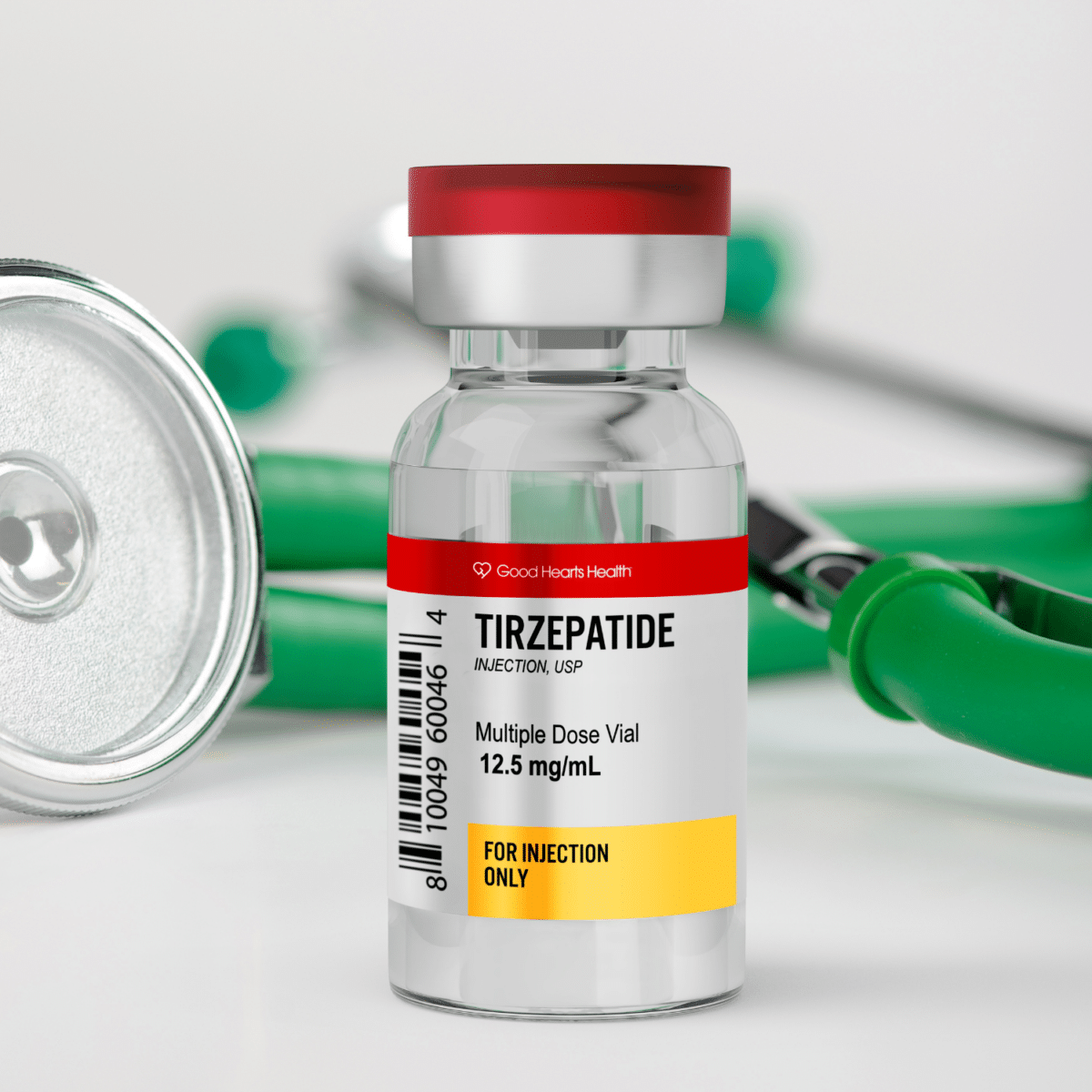
Medically authored by Dr. Mario Quiros, MD — Diplomate of the American Board of Obesity Medicine | Good Hearts Health | Last medically reviewed: June 2026
“How many milligrams do I take?” and “How do I measure that in units on a syringe?” — these are questions I answer every single day in my weight loss practice. If you’re taking compounded semaglutide or tirzepatide for weight loss, understanding your exact dose is critical for both safety and results.
This complete semaglutide and tirzepatide dosing guide covers everything: how doses are measured in milligrams, how to convert mg to mL, and exactly how many units to draw on an insulin syringe — including the specific dosing schedules we use at Good Hearts Health.
What Are Semaglutide and Tirzepatide?
Semaglutide and tirzepatide are GLP-1 receptor agonists (tirzepatide also targets GIP receptors) approved for weight management and type 2 diabetes. Compounded versions of both medications are prescribed by weight loss physicians and dosed via weekly subcutaneous injection using a standard U-100 insulin syringe.
What Is Your Semaglutide or Tirzepatide Dose in Milligrams?
Both Semaglutide and Tirzepatide are dosed in milligrams (mg). You should always start on the lowest dose and titrate upward based on three key factors:
1. How Long Have You Been at Your Current Dose?
It is recommended that you stay at each dose for a minimum of 4 weeks before increasing. This allows your body to acclimate to the medication and prevents side effects that can occur from increasing the dose too quickly.
2. Are You Experiencing Side Effects?
If you are having side effects at your current dose, do not increase your dosage until those side effects have resolved. Increasing too soon will likely make them worse.
3. Are You Losing Weight?
I recommend a consistent weight loss of 1.5 to 2 lbs per week as a target. If you are hitting this consistently, there is no need to increase your dose. I only recommend a dosage increase if weight loss falls below this threshold or you hit a plateau.
How to Convert Your Semaglutide or Tirzepatide Dose from mg to Units
Every compounded medication has a concentration expressed in mg/mL — meaning how many milligrams of the drug are dissolved in 1 mL of liquid. Every 1 mL equals 100 units on an insulin syringe.
Once you know your concentration and your desired dose in mg, you can calculate exactly how many units to draw up.
The Formula: mg to mL
Desired dose (mg) ÷ Concentration (mg/mL) = Volume to inject (mL)
Example — Semaglutide starting dose:
0.25 mg ÷ 5 mg/mL = 0.05 mL
Converting mL to Units on a Syringe
To convert mL to units, multiply by 100:
0.05 mL × 100 = 5 units
So a 0.25 mg dose of Semaglutide (5 mg/mL concentration) = 5 units on an insulin syringe.
How to Calculate Your Dose in mg If You Only Know Your Units
This is one of the most common questions I get from patients who are new to my practice or transferring from another provider. Many patients are told how many units to inject but don’t know what that equals in milligrams.
The Formula: Units to mg
(Units ÷ 100) × Concentration (mg/mL) = Dose in mg
Example — Tirzepatide patient taking 44 units at 17 mg/mL:
(44 ÷ 100) × 17 mg/mL = 7.5 mg
So 44 units of Tirzepatide at 17 mg/mL = 7.5 mg of the medication.
Good Hearts Health Dosing Schedules
The following are the dosing guidelines I use for patients at Good Hearts Health, based on the specific concentrations of Semaglutide and Tirzepatide we currently prescribe.
Starting dose for Semaglutide: 0.25 mg weekly = 5 units (0.05 mL) on the insulin syringe provided.
Starting dose for Tirzepatide: 2.5 mg weekly = 15 units (0.15 mL) on the insulin syringe provided.
Semaglutide Dosing Schedule (5 mg/mL Concentration)
| Dose (mg) | Units on Syringe | Duration |
|---|---|---|
| 0.25 mg | 5 units | 2–4 weeks |
| 0.5 mg | 10 units | 4 weeks |
| 1.0 mg | 20 units | 4 weeks |
| 1.7 mg | 34 units | 4 weeks |
| 2.4 mg | 48 units | 4 weeks |
Tirzepatide Dosing Schedule (17 mg/mL Concentration)
| Dose (mg) | Units on Syringe | Duration |
|---|---|---|
| 2.5 mg | 15 units | 2–4 weeks |
| 5.0 mg | 30 units | 4 weeks |
| 7.5 mg | 45 units | 4 weeks |
| 10.0 mg | 60 units | 4 weeks |
| 12.5 mg | 74 units | 4 weeks |
| 15.0 mg | 88 units | 4 weeks |
Important reminder: The goal is always the lowest effective dose. If you are tolerating the medication well and losing 1.5–2 lbs per week consistently, there is no reason to increase your dose. Only consider increasing after 4 weeks at your current dose if weight loss has plateaued.
Frequently Asked Questions About Semaglutide and Tirzepatide Dosing
Q: How do I know if my Semaglutide dose is working?
A consistent weight loss of 1.5–2 lbs per week indicates your dose is effective. If you are losing weight steadily, stay at your current dose — more is not always better.
Q: What happens if I increase my dose too quickly?
Increasing your dose before your body has acclimated increases the risk of side effects including nausea, vomiting, and GI discomfort. Always stay at each dose for at least 4 weeks.
Q: Can I calculate my Tirzepatide dose in units at home?
Yes. Use this formula: (Units ÷ 100) × Concentration (mg/mL) = Dose in mg. You will need to know the concentration of your specific medication vial.
Q: What concentration of Semaglutide does Good Hearts Health prescribe?
Good Hearts Health prescribes Semaglutide at 5 mg/mL and Tirzepatide at 17 mg/mL. If you are using medication from a different provider, confirm your concentration before calculating your dose.
Q: Is Tirzepatide dosed differently than Semaglutide?
Yes. While both medications are dosed in mg, Tirzepatide has a different concentration and dosing schedule. Always follow the schedule specific to your medication and concentration.
Q: How many units is 0.25 mg of semaglutide?
At a concentration of 5 mg/mL (the concentration used at Good Hearts Health), 0.25 mg of semaglutide equals 5 units on an insulin syringe. If your vial has a different concentration, divide 0.25 by your concentration and multiply by 100.
Q: How many units is 2.5 mg of tirzepatide?
At a concentration of 17 mg/mL (the concentration used at Good Hearts Health), 2.5 mg of tirzepatide equals approximately 15 units. Concentrations vary by pharmacy — always verify your specific vial.
Q: What syringe should I use for compounded semaglutide or tirzepatide?
Use a standard U-100 insulin syringe. Every 1 mL on a U-100 syringe equals 100 units, which is the basis for all unit calculations in this guide.
Final Thoughts from Dr. Q
One of my mentors used to tell me, “Life is complicated, but medicine makes sense!” I hope this guide on Semaglutide and Tirzepatide dosing has made things a little clearer. Understanding your dose — in mg, mL, and units — puts you in control of your weight loss journey and helps you use these powerful medications safely and effectively.
If you have any questions about your specific dosing, please don’t hesitate to reach out to our team at Good Hearts Health.
Additional Resources
- Semaglutide Clinical Trial — New England Journal of Medicine
- Tirzepatide Clinical Trial — New England Journal of Medicine
Medically authored by Dr. Mario Quiros, MD. Diplomate of the American Board of Obesity Medicine. Owner and Operator of Good Hearts Health.
Ready to Start a Physician-Supervised GLP-1 Weight Loss Program?
At Good Hearts Health, Dr. Mario Quiros provides personalized, board-certified concierge weight loss care using FDA-approved Semaglutide and Tirzepatide therapy. If you are considering GLP-1 therapy for weight loss, we offer a free initial consultation to see if our program is right for you.