Medically authored by Dr. Mario Quiros, MD — Board-Certified Emergency Medicine & Obesity Medicine Physician | Good Hearts Health
Can GLP-1 medications cause NAION, a rare optic nerve condition that leads to sudden vision loss? On November 9, 2026, the FDA added a warning about GLP-1 NAION risk to every GLP-1 medication label. The risk is real enough to warn about, but it is still uncertain, and it is very small in absolute terms.
If you take semaglutide (Ozempic, Wegovy) or tirzepatide (Mounjaro, Zepbound), you may have seen alarming headlines claiming these medications “cause blindness.” The truth is more nuanced, and far more useful to understand than the headlines suggest.
This guide covers what NAION is, who is at risk, how often it actually happens, what the research does and does not show, and why the risk looks different for people with diabetes, people with obesity alone, and otherwise healthy people using these medications for weight loss.
What Is NAION?
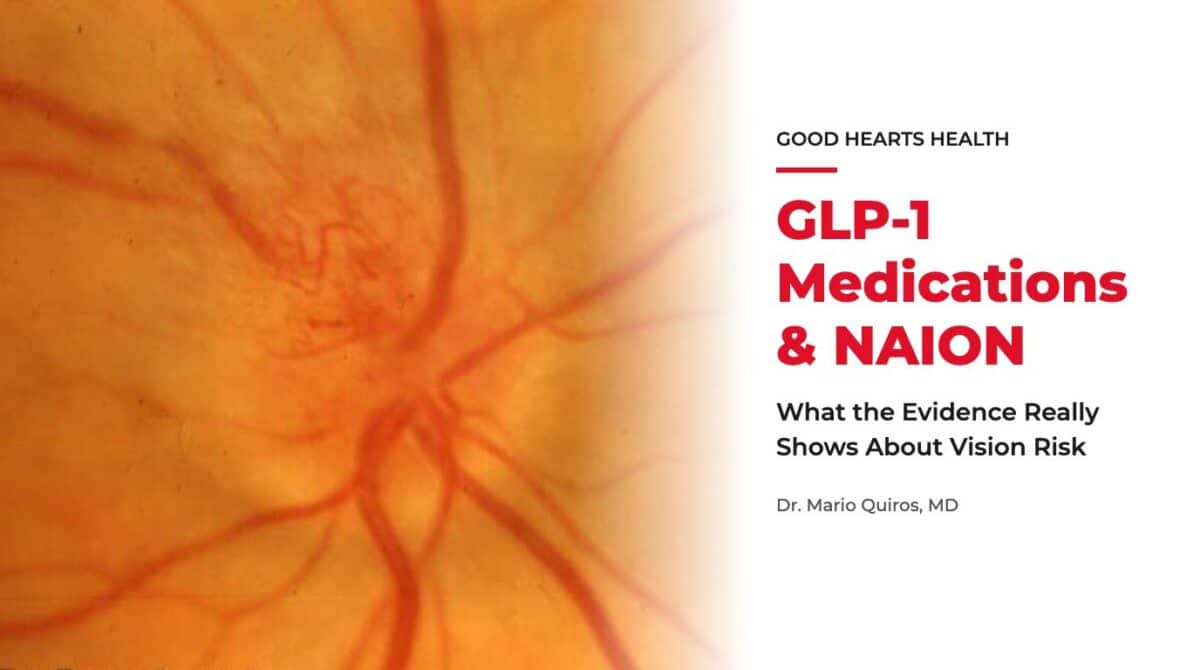
Non-arteritic anterior ischemic optic neuropathy (NAION) is sometimes called an “eye stroke.” Blood flow to the front of the optic nerve, where it enters the back of the eye (the optic disc), suddenly drops. The nerve fibers there are starved of oxygen, swell, and some of them die.
The typical story is sudden, painless vision loss in one eye, often noticed on waking. Patients describe a dark shadow or blur, usually in the upper or lower half of their vision.
NAION is the most common acute optic neuropathy in adults over 50. There is no proven treatment to reverse it. Some patients partly recover, but many are left with permanent vision loss in the affected eye. That is why even a small increase in risk deserves attention.
Important note: “Non-arteritic” separates NAION from arteritic AION, which is caused by giant cell arteritis, an inflammatory disease of the blood vessels. That is a different condition and a medical emergency in its own right.
NAION Risk Factors: Who Is Vulnerable Before Starting a GLP-1?
NAION almost never happens out of the blue. It happens when a structurally vulnerable optic nerve meets a drop in blood flow or oxygen delivery. Known risk factors include:
- A “disc at risk”: the single strongest risk factor. This is a small, crowded optic disc with little or no central cup (a cup-to-disc ratio of about 0.2 or less). Up to 97% of NAION patients have this anatomy. It is something you are born with, and it can only be seen on an eye exam.
- Obstructive sleep apnea: associated with a more than six-fold higher risk of NAION. Repeated drops in oxygen overnight are thought to stress an already crowded nerve.
- Diabetes: damages small blood vessels, including those supplying the optic nerve.
- High blood pressure, high cholesterol, and atherosclerosis: these impair blood vessel health. Overly aggressive blood pressure treatment that causes low blood pressure at night may also play a role.
- Age over 50 and smoking.
- Certain medications: amiodarone and the PDE5 inhibitors (sildenafil, tadalafil) have long been discussed as possible contributors.
- Sudden drops in blood pressure or blood volume: severe dehydration, blood loss, or long surgeries.
Important limitation: Many of these risk factors, especially obesity, sleep apnea, diabetes, and hypertension, are the very conditions GLP-1 medications are prescribed for. This is the central problem in interpreting every study on this topic, and we will come back to it.
The Actual Incidence: How Rare Is NAION on GLP-1 Medications?
NAION affects roughly 2 to 10 people per 100,000 per year, or about 6,000 new cases a year in the United States. Even in the studies that found a higher risk with GLP-1 medications, the increase works out to a few extra cases per 100,000 people per year.
| Population and Comparison | NAION Without GLP-1 (per 100,000 person-years) | NAION With GLP-1 (per 100,000 person-years) | Extra Cases (per 100,000 person-years) |
|---|---|---|---|
| General population, mostly adults over 50 | 2.3 to 10.3 | Not applicable | Not applicable |
| FDA pooled analysis of 126 randomized trials, all indications | 3.8 (placebo or other diabetes drug) | 6.4 | About 2.6 |
| Danish adults with type 2 diabetes, semaglutide vs. SGLT-2 inhibitor (unadjusted) | 11.8 | 21.9 | About 14 after adjustment |
What the numbers mean in practice:
- In the FDA’s pooled trial data, about one extra NAION case would occur for every 38,000 patient-years of GLP-1 treatment.
- In the Danish diabetes registry, the adjusted excess was about 1.4 cases per 10,000 person-years, or roughly one extra case for every 7,000 years of treatment in a higher-risk diabetic population.
- The European Medicines Agency classifies NAION as a “very rare” side effect of semaglutide, affecting up to 1 in 10,000 people treated for at least a year.
Important note: Relative risk headlines (“2 times,” “4 times,” “7 times” the risk) sound dramatic because the starting number is so small. Doubling a very small risk still leaves a very small risk.
What the GLP-1 NAION Research Shows: A Signal, Not a Settled Answer
The evidence is inconsistent. The best-designed studies in people with type 2 diabetes point to roughly a doubling of risk. Studies in people with obesity but no diabetes are mixed, and several large ones found no increase at all.
| Year | Study | Population | What It Found |
|---|---|---|---|
| 2026 | FDA review (126 randomized trials plus FDA Sentinel data) | All approved indications | 6.4 vs. 3.8 NAION cases per 100,000 person-years; led to class-wide label warning |
| 2026 | Dhivagaran et al. meta-analysis, Neurology | About 1.5 million people, 5 studies | Relative risk 2.52 vs. non-GLP-1 drugs, low-to-moderate certainty |
| 2026 | Reynolds et al., Annals of Internal Medicine (Rutgers) | New users with type 2 diabetes | 8.5 vs. 5.5 ischemic optic neuropathy cases per 10,000 over 18 months vs. SGLT-2 inhibitors; minimal difference in women and people under 50 |
| 2026 | Ueda et al., Annals of Internal Medicine (Karolinska) | New users with type 2 diabetes, Scandinavia | 0.04% vs. 0.02% at 1 year vs. SGLT-2 inhibitors; risk ratio 1.93, borderline significance |
| 2026 | Large multicenter analysis presented in April | Over 1.2 million patients | No increase in obesity without diabetes; lower odds with semaglutide in type 2 diabetes |
| 2026 | Lakhani et al., British Journal of Ophthalmology (FDA adverse event reports) | 31,774 semaglutide reports | Reporting signal strongest for Wegovy, then Ozempic; no signal for tirzepatide |
| 2025 | Simonsen et al., Danish–Norwegian registries | About 61,000 semaglutide users with type 2 diabetes | Hazard ratio 2.81 vs. SGLT-2 inhibitors; absolute excess 1.4 per 10,000 person-years |
| 2025 | Chou et al., TriNetX (21 countries) | About 136,000 people with diabetes, obesity, or both | No significant increase in any group |
| 2024 | Hathaway et al., JAMA Ophthalmology (Mass Eye and Ear) | 1,689 patients at one neuro-ophthalmology center | Hazard ratio 4.28 in diabetes and 7.64 in overweight/obesity; based on 37 total semaglutide cases |
Why the Studies Disagree
- Referral bias: The 2024 study that started this conversation drew from patients already referred to a specialty eye center, where NAION is far more common than in the general population.
- Tiny case counts: NAION is so rare that a handful of cases can swing a hazard ratio from 1 to 7. Wide confidence intervals are the rule.
- Confounding by indication: People prescribed GLP-1 medications are, on average, heavier and more likely to have sleep apnea and hypertension than the comparison groups. Statistical adjustment helps, but cannot fully erase this.
- Coding problems: Insurance and registry codes for NAION are imprecise. Some “cases” may be other optic nerve conditions, and some true cases may be missed.
- Adverse event reports cannot measure risk: FDA reporting data shows what gets reported, which is heavily shaped by media attention. It cannot tell us how often NAION actually occurs.
Risk Comparison: Diabetic vs. Non-Diabetic vs. Patients With No Significant Health Conditions
The risk is not the same for everyone. The evidence is strongest, and the starting risk is highest, in people with type 2 diabetes. It gets weaker and the baseline drops as you move toward otherwise healthy patients.
| Type 2 Diabetes | Overweight or Obesity, No Diabetes | No Significant Health Conditions | |
|---|---|---|---|
| Baseline NAION risk | Highest: diabetes damages small vessels, often alongside hypertension and sleep apnea | Moderate: obesity and undiagnosed sleep apnea raise risk | Lowest: mainly depends on optic disc anatomy and age |
| Strength of evidence for a GLP-1 link | Moderate: several large, well-designed registry studies agree on about a 2-fold increase | Weak and conflicting: one small referral-center study found a 7.6-fold increase; larger studies found none | Essentially none: no study has examined this group directly |
| Best estimate of relative risk | About 2 to 3 times | Uncertain; possibly no increase | Unknown |
| Best estimate of absolute excess | About 1 to 1.5 extra cases per 10,000 person-years | Likely smaller, given a lower baseline | Likely very small, given a very low baseline |
| Who within the group is most affected | Men, adults over 50, people with eye or heart disease | Possibly those with sleep apnea or a crowded optic disc | Possibly those with a crowded optic disc |
Three points stand out:
- The diabetes signal is the most reproducible. Studies from Denmark, Norway, Sweden, and the United States using active comparators (patients starting SGLT-2 or DPP-4 inhibitors) keep finding a modest increase. The FDA said these methodologically rigorous studies consistently showed it.
- The obesity-only signal is fragile. The headline 7.64-fold figure came from 20 cases versus 3, in a population already referred for eye problems. Larger multinational datasets have not reproduced it.
- Healthy patients are a data gap, not proof of safety. The Rutgers study did find minimal differences in women and adults under 50, which describes many weight-loss patients. That is reassuring, but it is a subgroup finding in a diabetic population, not a direct study of healthy people.
No Known Pathway: Why GLP-1 NAION Causation Is Still Unproven
No one has shown how a GLP-1 medication would injure the optic nerve. In its November 2026 review, the FDA said its animal data did not identify a mechanism. That matters: a drug side effect is far more credible when there is a biological explanation for it.
Researchers have proposed several hypotheses, none proven:
- Lower perfusion pressure at night: GLP-1 medications modestly lower blood pressure, and reduced eating and drinking can lower blood volume. In a crowded optic disc, a small nighttime dip in perfusion could, in theory, tip a vulnerable nerve into ischemia. This is the most commonly proposed explanation.
- Rapid metabolic shifts: In diabetes, rapidly improving blood sugar is known to briefly worsen diabetic retinopathy (“early worsening”). A similar effect on optic nerve blood flow has been proposed. It would not explain risk in people without diabetes.
- Direct receptor effects: GLP-1 receptors are present in the retina and optic nerve. However, in laboratory models GLP-1 activity is generally protective for nerve cells and anti-inflammatory, which argues against a direct toxic effect.
- Confounding rather than causation: The link may simply reflect the people who take these drugs. Obesity, sleep apnea, diabetes, and hypertension all independently cause NAION. If a study does not fully capture something like undiagnosed sleep apnea, the drug looks guilty by association.
Important limitation: Researchers at Rutgers noted that GLP-1 medications’ anti-inflammatory properties make an ischemic pathway biologically uncertain. They raised the possibility that earlier signals reflect residual confounding rather than a true drug effect. That question remains open.
What the FDA and European Regulators Have Said
- FDA, November 9, 2026: All GLP-1 medications must now list a potential increased risk of NAION in the Warnings and Precautions section of their labels. The warning covers semaglutide, tirzepatide, liraglutide, dulaglutide, exenatide, and orforglipron. NAION cases have been reported with every GLP-1 medication on the market. If NAION occurs, the FDA advises doctors to consider stopping the medication unless the benefits clearly outweigh the risk.
- European Medicines Agency, June 2025: Concluded that NAION is a very rare side effect of semaglutide (Ozempic, Wegovy, Rybelsus), affecting up to 1 in 10,000 users. The European review covered semaglutide only.
- Neuro-ophthalmology societies: The North American Neuro-Ophthalmology Society and American Academy of Ophthalmology have said the increased NAION risk is much lower than the overall health risks these medications treat. They do not recommend routinely stopping therapy, even after NAION in one eye.
Important note: A label warning is not a finding that the drug causes NAION. The FDA itself called the risk “potential.” The warning ensures patients and doctors know to act quickly if symptoms appear.
NAION Warning Signs on a GLP-1 and What to Do
Contact your physician and get a same-day eye evaluation if you notice any of the following, especially in one eye:
- Sudden, painless loss or dimming of vision
- A dark shadow or blind area, often in the upper or lower half of your vision
- Colors looking washed out
- New blurry or missing areas in your central vision
If you are taking a GLP-1 medication, these steps make sense:
- Tell your prescriber about any eye history, especially prior NAION, unexplained vision loss, or being told you have a “crowded” optic nerve.
- Get screened for sleep apnea if you snore, wake unrefreshed, or have daytime sleepiness. Treating sleep apnea lowers NAION risk on its own.
- Stay hydrated and eat enough, particularly during dose increases when appetite and fluid intake drop. Our guide to the ideal diet for GLP-1 patients covers how to fuel your body while your appetite is suppressed.
- Have your blood pressure monitored as you lose weight. Blood pressure medications often need to be reduced to avoid low readings.
- Do not stop your medication on your own because of headlines. Talk to your physician first. The same applies to other side effects that cause worry, such as hair loss on GLP-1 medications.
Dr. Q’s Take
I want to be straight with my patients: we do not yet know whether GLP-1 medications cause NAION. What we have is a statistical association that is reasonably consistent in people with type 2 diabetes, inconsistent in people with obesity alone, and essentially unstudied in otherwise healthy patients. No one has identified a biological pathway that explains it. The FDA’s new warning is appropriate, but the agency itself chose the word “potential,” and that word was chosen carefully.
The hardest part of this question is that the people who take these medications already carry the risk factors for NAION. Obesity, sleep apnea, diabetes, and high blood pressure each raise the risk on their own. Untangling the drug from the disease it treats is extremely difficult in observational data, and NAION is so rare that a few miscoded cases can change a study’s conclusion. When one study finds a seven-fold increase and a much larger one finds no increase at all, the honest conclusion is that the true number is uncertain, not that the scariest number is correct.
What I am confident about is scale. Even if we accept the higher estimates as causal, the excess risk is on the order of one to a few extra cases per 10,000 to 100,000 patient-years. Compare that to what untreated obesity and diabetes do to the heart, kidneys, liver, joints, and the eyes themselves. For most of my patients, the benefit-to-risk calculation still clearly favors treatment. Still, every patient should know the warning signs, because if this does happen, speed matters.
My bottom line: this is a rare, possible risk that deserves informed consent, not fear. Know the symptoms, tell us about your eye history, and make the decision with a physician who knows your full picture.
Frequently Asked Questions About GLP-1 Medications and NAION
Q: Do GLP-1 medications cause blindness?
There is no proof that they do. Some studies link GLP-1 medications to a small increase in NAION, a rare condition that can cause permanent vision loss in one eye. Whether the drug causes it, or the association reflects the conditions these drugs treat, is still unknown.
Q: Is the risk the same for semaglutide and tirzepatide?
Most of the research has focused on semaglutide because it has been available longer. Data on tirzepatide is limited, and one 2026 adverse event analysis found no signal for it. The FDA applied its warning to the entire class.
Q: I don’t have diabetes. Does this apply to me?
The evidence is weakest in people without diabetes. Large studies of people with obesity alone have mostly found no increase, but the data is not strong enough to rule out a small risk.
Q: Should I stop my medication?
Not without talking to your physician. For most people, the proven benefits outweigh a small, uncertain risk. If you have had NAION before, or develop sudden vision changes, that conversation becomes more important.
Q: How quickly does NAION happen after starting a GLP-1?
In the 2024 Mass Eye and Ear study, most cases occurred within the first year of treatment. This is one reason to watch for symptoms most closely during the first months and during dose increases.
References & Further Reading
- FDA Requires Class-Wide GLP-1 RA Labeling Changes for Potential NAION Risk. Pharmacy Times. November 9, 2026.
- FDA to Require NAION Risk Warning for GLP-1 Therapies. Healio. November 9, 2026.
- PRAC concludes eye condition NAION is a very rare side effect of semaglutide medicines Ozempic, Rybelsus and Wegovy. European Medicines Agency. June 6, 2025.
- Hathaway JT, et al. Risk of Nonarteritic Anterior Ischemic Optic Neuropathy in Patients Prescribed Semaglutide. JAMA Ophthalmology. 2024.
- Simonsen E, et al. Use of semaglutide and risk of non-arteritic anterior ischemic optic neuropathy: A Danish–Norwegian cohort study. Diabetes, Obesity and Metabolism. 2025.
- Chou CC, et al. Association between Semaglutide and Non-Arteritic Anterior Ischemic Optic Neuropathy: A Multinational Population-Based Real-World Study. 2025.
- Reynolds K, et al. GLP-1 receptor agonists and ischemic optic neuropathy. Annals of Internal Medicine. 2026.
- More Studies Tie GLP-1s to Small Risks for Eye Complications. Healio. July 14, 2026.
- Grossman SN, Biousse V, Newman NJ. Editorial on GLP-1 receptor agonists and NAION. Neurology. 2026.
- Lakhani M, et al. Ischemic optic neuropathy with semaglutide: global observational analysis of sex- and formulation-specific risk. British Journal of Ophthalmology. 2026.
- New Risk Factor Identified for Potentially Blinding Condition. UC Davis Health. 2023.
Ready to Start a Physician-Supervised GLP-1 Weight Loss Program?
At Good Hearts Health, Dr. Mario Quiros provides personalized, board-certified concierge weight loss care using FDA-approved Semaglutide and Tirzepatide therapy — including a review of your full health history, eye health, and sleep apnea risk before treatment begins. If you are considering GLP-1 therapy for weight loss, we offer a free initial consultation to see if our program is right for you.
Book your free consultation with Good Hearts Health today →
Medical Disclaimer: This article is for educational purposes only and does not constitute medical advice, diagnosis, or treatment. Always consult your healthcare provider before making changes to your medication regimen or treatment plan. If you experience sudden vision loss, seek medical care immediately.
Medically Authored by Dr. Mario Quiros, MD. Board-Certified Emergency Medicine and Obesity Medicine Physician. Owner and Operator of Good Hearts Health.