
Are Peptides Safe? A Physician’s Guide to FDA-Approved vs. Non-FDA Approved Peptides
Medically authored by Dr. Mario Quiros, MD — Board-Certified Emergency Medicine & Obesity Medicine Physician | Good Hearts Health
If you’ve been on social media lately and your algorithm has pegged you as someone interested in health, chances are you’ve been flooded with content about peptide therapy. It reminds me of the old Apple commercial — but instead of “There’s an app for that,” it seems like no matter what you’re feeling these days, “There’s a peptide for that.”
Stronger muscles? Cut fat? Younger skin? There’s a peptide stack for all of it. But here’s the question nobody on your TikTok feed is asking: Are peptides actually safe?
As a board-certified physician who prescribes FDA-approved peptides daily, I want to give you an honest, evidence-based answer.
What Are Peptides? (And Are You Already Taking One?)
Before diving into the controversy, let’s define the term. Peptides are short chains of amino acids that act as signaling molecules in the body. They help regulate essential functions like hormone production, immune response, tissue repair, and metabolism. Because they break down in the stomach when taken orally, peptides are generally administered subcutaneously (via injection under the skin) to maximize bioavailability.
Peptides can be naturally occurring — produced by the human body, animals, plants, or microorganisms — or synthetic, meaning created in a laboratory to target specific receptors.
Here’s what surprises many of my patients: they’re already taking peptides and don’t even know it.
- Insulin — a peptide that revolutionized diabetes treatment over a century ago
- Semaglutide (Ozempic/Wegovy) — an FDA-approved GLP-1 peptide for type 2 diabetes and obesity
- Tirzepatide (Mounjaro/Zepbound) — in my clinical opinion, the most effective FDA-approved peptide ever developed
These are all FDA-approved synthetic peptides backed by years of clinical trials demonstrating both safety and efficacy. There are currently approximately 80 FDA-approved peptides, 200 in clinical development, and over 600 in pre-clinical trials. What’s being sold on social media represents a tiny, largely unregulated slice of a much larger scientific space.
The Peptides Being Sold on Social Media: What You’re Actually Being Offered
Here’s a breakdown of the most commonly marketed non-FDA approved peptides you’ll find online and on social media:
For muscle, fat loss, and anti-aging: The Morelin family of peptides (including Ipamorelin and CJC-1295) claim to stimulate the pituitary gland, boost growth hormone, build muscle, and slow aging. Theoretical benefits? Sure. Proven safety data? No.
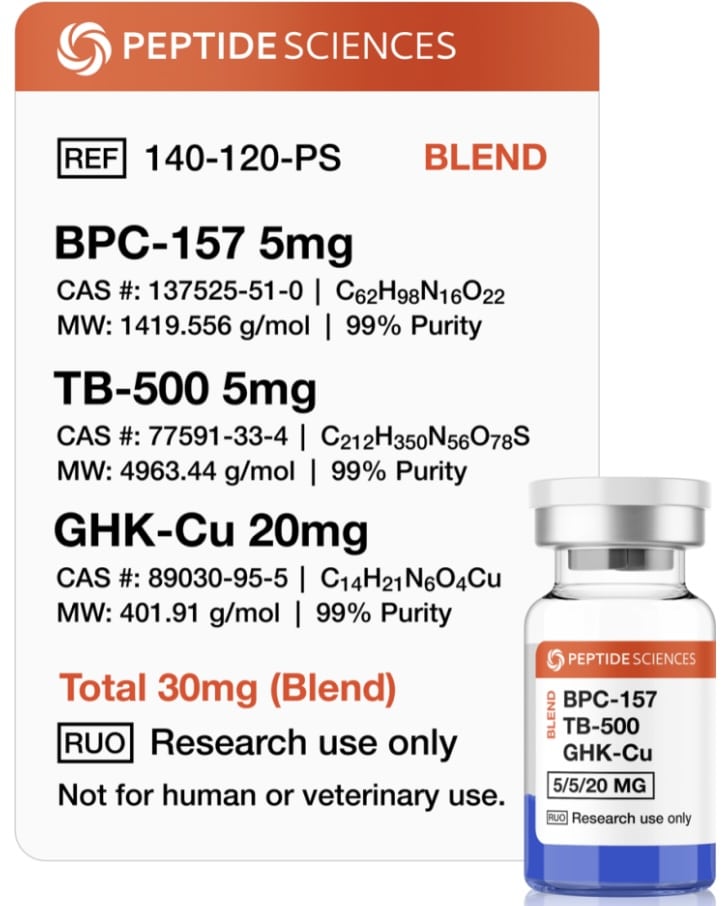
For skin and collagen (“The Glow Blend”): A combination of BPC-157, TB-500, and GHK-Cu — marketed for anti-inflammatory effects, tissue repair, and increased collagen production.
For joint pain and injury recovery (“The Wolverine Stack”): BPC-157 + TB-500, promoted to accelerate healing of tendons, ligaments, and muscle tissue.
For energy and metabolism: MOTS-c and NAD+ (note: NAD+ is not actually a peptide) are marketed to boost mitochondrial function and metabolic efficiency.
For tanning and libido: Melanotan II, injected to stimulate melanocytes — giving a tan without sun exposure while reportedly increasing libido.
The list goes on. Each of these sounds compelling. But here’s what the influencers selling them aren’t telling you.
Why I Don’t Prescribe Non-FDA Approved Peptides
1. There Is No Safety or Efficacy Data
The most important thing I can tell you is this: anyone claiming these peptides are safe and effective is lying to you — not because they’re necessarily malicious, but because that data simply does not exist.
Most of the peptides being sold on social media were banned by the FDA in September 2023 for presenting “significant safety risks.” They have not undergone the clinical trials required to demonstrate efficacy or safety — short-term or long-term.
The theoretical benefits are real — these peptides do target specific signaling pathways. But so do the theoretical risks:
- Growth hormone-stimulating peptides may help build muscle, but they can also accelerate the growth of undiagnosed tumors or precancerous cells.
- Melanotan II may darken your skin without sun exposure, but stimulating melanocytes may also increase your risk of melanoma and other skin cancers.
Theoretical benefit without clinical data is not medicine. It’s an experiment.
2. They Are No Longer Being Produced by Credentialed Pharmacies
Before the 2023 FDA ban, some of these peptides could be legally sourced from credentialed compounding pharmacies — the same type of pharmacies that produce GLP-1 medications today. They required a physician’s prescription and were used under medical supervision. I was still reluctant to prescribe them then due to safety concerns, but at least a regulated framework existed.
That framework is gone.
Today, these peptides are produced and sold for “research use only” with labels stating “not for human consumption.” The majority of source material is coming from unregulated manufacturers in China, raising serious concerns about purity, contamination, and dosing accuracy.
Most of these peptides no longer even require a prescription. You can purchase them online by simply clicking a box claiming you’re buying them for research purposes — not to inject into your body.
Prescribing a medication banned by the FDA and labeled “not for human consumption” is, in my view, a direct violation of a physician’s oath to do no harm.
Dr. Q’s Take: My Official Position on Non-FDA Approved Peptides
I view the current non-FDA approved peptide market as an experiment-at-your-own-risk space.
Think of it this way: imagine if Arnold Schwarzenegger had a TikTok account in the 1970s documenting his bodybuilding and anabolic steroid use — before anyone understood the long-term cardiovascular consequences. That’s exactly what’s happening today with FDA-banned peptides, promoted by so-called health experts and wellness influencers.

I don’t promote unproven treatments to generate revenue. I don’t take medical advice from social media influencers. And I don’t experiment with my patients’ health. Without reliable clinical data, it’s nearly impossible to separate cutting-edge medicine from the next healthcare cautionary tale.
If you choose to use non-FDA approved peptides despite these risks, at minimum:
- Ask exactly where they are sourced and who manufactures them
- Seek supervision from a physician who specializes in the field
- Get baseline labs and ongoing monitoring for adverse reactions before and during use
Frequently Asked Questions About Peptide Safety
Q: Are all peptides banned by the FDA?
No. There are approximately 80 FDA-approved peptides, including insulin, semaglutide (Ozempic), and tirzepatide (Mounjaro). The peptides banned in 2023 are specific non-FDA approved compounds like BPC-157, TB-500, and Melanotan II that were being compounded without adequate safety data.
Q: Is BPC-157 safe to use?
BPC-157 has not undergone the clinical trials necessary to establish safety or efficacy in humans. It was banned by the FDA in September 2023 due to significant safety risks. It is also prohibited by the World Anti-Doping Agency (USADA).
Q: Can a doctor legally prescribe non-FDA approved peptides?
No. Because these peptides are banned by the FDA for human use and sold only for “research purposes,” they cannot legally be prescribed by a physician. Any doctor claiming to “prescribe” these substances should raise serious red flags.
Q: What’s the difference between semaglutide and BPC-157?
Both are peptides, but they differ in one critical way: semaglutide (Ozempic/Wegovy) is FDA-approved with extensive clinical trial data demonstrating safety and efficacy. BPC-157 has no such data and was banned by the FDA.
The Bottom Line
The peptide space is real, rapidly evolving, and full of genuine promise. GLP-1 medications like semaglutide and tirzepatide are proof of what happens when peptide science is done right — rigorous research, clinical trials, FDA approval, and physician oversight. Hundreds more peptides are in the pipeline that may one day transform medicine.
But what’s being sold to you on Instagram and TikTok right now is not that. It’s unregulated, unsupervised, and unproven.
Proceed with caution. Stay safe. Stay educated. Stay healthy.
References & Further Reading
- FDA: Bulk Drug Substances — Significant Safety Risks
- NPR: Peptides, Science, Muscle Growth & Longevity
- CNN: Peptides and Unregulated Influencers
- DJ Holt Law: The Unregulated World of Peptides
- USADA: BPC-157 — Prohibited
Ready to Start a Physician-Supervised GLP-1 Weight Loss Program?
At Good Hearts Health, Dr. Mario Quiros provides personalized, board-certified concierge weight loss care using FDA-approved Semaglutide and Tirzepatide therapy. If you are considering GLP-1 therapy for weight loss, we offer a free initial consultation to see if our program is right for you.
Book your free consultation with Good Hearts Health today →
Medically Authored by Dr. Mario Quiros, MD. Board-Certified Emergency Medicine and Obesity Medicine Physician. Owner and Operator of Good Hearts Health.