
Retatrutide Weight Loss Risks: What to Know Before Using It for Cosmetic Weight Loss
Medically authored by Dr. Mario Quiros, MD — Board-Certified Emergency Medicine & Obesity Medicine Physician | Good Hearts Health · Updated September 2026
Is Retatrutide the most powerful weight-loss drug ever developed — or the most dangerous one to use without a prescription? As buzz around this unapproved triple-hormone agonist explodes on social media and grey-market peptide sites, thousands of people are self-injecting a compound that has never cleared FDA review. This article breaks down the retatrutide weight loss risks, the science, and why sourcing Retatrutide outside a clinical trial could cost you far more than money.
What Is Retatrutide?
Retatrutide (development code LY3437943) is an investigational drug developed by Eli Lilly that simultaneously activates three hormonal receptors: GLP-1 (glucagon-like peptide-1), GIP (glucose-dependent insulinotropic polypeptide), and glucagon receptors. This triple-agonist mechanism makes it fundamentally different from every weight-loss drug currently on the market.
Phase 3 clinical trial results from the TRIUMPH program have been striking:
- TRIUMPH-1: Participants on 12 mg lost an average of nearly 30% of body weight (about 70 lbs) at 80 weeks.
- TRIUMPH-4: Participants with obesity and knee osteoarthritis lost an average of 28.7% of body weight at 68 weeks.
- TRANSCEND-T2D-1: Participants with type 2 diabetes lost an average of 16.8% at 40 weeks.
- TRIUMPH-2 and TRIUMPH-3: In participants with obesity plus type 2 diabetes or established cardiovascular disease, retatrutide also met its primary endpoints, though average weight loss was lower than in TRIUMPH-1.
For context, semaglutide (Wegovy) produces roughly 15% weight loss at 68 weeks, and tirzepatide (Zepbound) roughly 20–22%. Retatrutide’s numbers are unprecedented in pharmaceutical obesity treatment. However, retatrutide is not FDA-approved. As of September 2026, it remains an investigational compound available only through Eli Lilly’s clinical trials and a newly registered pre-approval expanded access program. Lilly has said it plans to submit its FDA application in the first quarter of 2027, so approval is unlikely before late 2027. For anyone weighing the risks of retatrutide, this unapproved status is the single most important fact to understand.
How Retatrutide Differs from Other GLP-1 Medications
This is a distinction many people using grey-market retatrutide do not fully understand. Retatrutide is not a GLP-1 drug — it is a triple agonist that happens to include GLP-1 activity.
Here is how the three receptor pathways work:
1. GLP-1 Receptor (GLP-1R): Reduces appetite, slows gastric emptying, and regulates blood sugar. Activated by semaglutide, tirzepatide, and retatrutide.
2. GIP Receptor (GIPR): Enhances insulin release after meals and modulates how energy from food is stored and used. Activated by tirzepatide and retatrutide.
3. Glucagon Receptor (GCGR): Signals the liver to release stored energy, raises resting energy expenditure, and promotes fat oxidation. Activated by retatrutide only.
Semaglutide (Ozempic/Wegovy) targets GLP-1 alone. Tirzepatide (Mounjaro/Zepbound) targets GLP-1 and GIP. Retatrutide activates all three simultaneously. The glucagon receptor activation is what sets retatrutide apart — and what introduces an entirely new category of risks.
Retatrutide’s potency profile is also unusual: compared to the body’s own hormones, retatrutide is 8.9 times more potent at GIPR than endogenous GIP, while being somewhat less potent than natural GLP-1 and glucagon at their respective receptors. This engineered potency means the drug operates at intensities the human body has never experienced from natural hormone signaling.
The Glucagon Factor: Artificially Ramping Up Your Metabolism
The glucagon receptor agonism in retatrutide is marketed as a metabolic advantage — and in one sense, it is. By activating glucagon receptors, retatrutide increases resting energy expenditure, promotes fat oxidation in the liver, and helps reduce visceral adipose tissue more aggressively than GLP-1 drugs alone. This is why retatrutide produces more weight loss than tirzepatide or semaglutide.
But artificially sustaining elevated glucagon signaling is a core component of retatrutide weight loss risks that are not present with GLP-1-only medications:
Elevated heart rate. Glucagon receptor activation is the primary driver of retatrutide’s observed heart rate increases — an average of 6.7 beats per minute at the 12 mg dose in Phase 2 trials. No comparable heart rate increase is observed with semaglutide alone.
Hepatic glucose production. Glucagon signals the liver to release stored glucose. While the concurrent GLP-1 activity largely counteracts the blood sugar-raising effect, the hepatic stress of continuous glucagon receptor stimulation is not yet fully characterized in long-term studies. Hepatic stress may be more significant when used for cosmetic weight loss as glycogen stores get depleted from already healthy livers.
Metabolic dependency. When glucagon receptors are chronically stimulated pharmacologically, the body’s own glucagon sensitivity and signaling pathways may be altered — with implications for what happens when the drug is stopped (discussed below).
Unknown long-term effects. Semaglutide has years of post-market safety data. Tirzepatide has a shorter but growing track record. Retatrutide has no such safety data. The glucagon component means we are in genuinely uncharted territory regarding what happens to metabolic function after 3, 5, or 10 years of use.
Body Composition Effects: Fat Loss, Muscle Loss, and What the Data Shows
Clinical data from Phase 2 body composition substudies show:
- 75–85% of total weight lost is fat mass, with 15–25% coming from lean tissue
- Visceral adipose tissue (the dangerous fat surrounding organs) drops significantly even at lower doses
- Total fat mass percentage drops from baseline by up to 26.1% at the 8 mg dose
By comparison, here is how retatrutide stacks up directly against tirzepatide — the closest approved drug in terms of mechanism and efficacy:
- Tirzepatide (SURMOUNT-1 body composition substudy): Approximately 25–29% of total weight lost is lean mass, with 71–75% fat mass.
- Retatrutide (Phase 2 body composition substudy): Approximately 15–25% of total weight lost is lean mass, with 75–85% fat mass.
The absolute lean mass caveat: Retatrutide wins on percentage of lean mass preserved, but may lose on absolute lean mass lost due to the sheer magnitude of weight loss. A patient losing 40 lbs on tirzepatide at 27% lean loss = ~10.8 lbs of lean mass lost. A patient losing 70 lbs on retatrutide at 20% lean loss = ~14 lbs of lean mass lost.
Important limitation: No head-to-head body composition trial between these two drugs exists. These figures come from separate trials with different populations, dose schedules, and durations. A true apples-to-apples comparison has not been published.
Without concurrent resistance training and adequate protein intake (at least 1.2–1.6 g/kg body weight), lean mass loss accelerates significantly on any GLP-1-class medication.
For cosmetic users, the risk-benefit calculus changes substantially. The trial data above come from people with obesity, and what I am seeing in lean, gym-going users is quite different (see Dr. Q’s Take below and my deep dive on the dangers of retatrutide in gym culture).
People pursuing Retatrutide for aesthetic weight loss rather than medical obesity treatment are often starting from a lower baseline BMI. The cardiovascular and joint-health benefits are smaller, while the risks of lean mass depletion, metabolic disruption, and rebound weight gain remain the same — or are amplified.
Cardiovascular Risks: What the Heart Rate Data Reveals
Among retatrutide weight loss risks, the cardiovascular profile is one of the most important differentiators from semaglutide and tirzepatide — and one of the least-discussed risks among grey-market users.
Heart rate increases by drug:
- Semaglutide: approximately +1–4 bpm
- Tirzepatide: approximately +2–4 bpm
- Retatrutide: approximately +6.7 bpm at 12 mg — driven specifically by glucagon receptor activation
For most healthy individuals, a 6–7 bpm increase is manageable. But this average obscures individual variation — some patients experience larger increases, and a sustained resting heart rate above 100 bpm (tachycardia) carries independent cardiovascular risk.
Populations who should not self-administer grey-market retatrutide: individuals with pre-existing tachycardia or arrhythmias, hyperthyroidism, heart failure, or anyone taking SNRIs, stimulants, or other sympathomimetic medications.
There is no completed cardiovascular outcomes trial (CVOT) for retatrutide. Semaglutide has the SUSTAIN and SELECT trials demonstrating cardiovascular benefit. Tirzepatide’s SURPASS-CVOT has reported results in type 2 diabetes, and an obesity-specific outcomes trial (SURMOUNT-MMO) is still ongoing. Retatrutide’s outcomes trial, TRIUMPH-Outcomes, is underway but is not expected to finish until around 2029. We do not know whether it increases or decreases the risk of heart attack, stroke, or cardiovascular death over a multi-year period.
One nuance worth noting: retatrutide produces significant reductions in blood pressure alongside the heart rate increase. Reduced blood pressure independently reduces cardiovascular risk. Whether this offsets the heart rate concern over the long term is simply unknown.
Rebound Weight Gain: Why Stopping Retatrutide May Be Harder Than Stopping Other GLP-1 Medications
Rebound weight gain is among the most underappreciated retatrutide weight loss risks. Weight regain after discontinuing GLP-1-class medications is well-documented. Studies of semaglutide show patients regain roughly two-thirds of lost weight within one year of stopping the drug. Tirzepatide data show similar patterns. Retatrutide likely carries a higher rebound risk — for three compounding reasons:
1. Greater total weight loss means greater regain potential. If you lose 60 lbs on retatrutide versus 30 lbs on semaglutide, there is simply more weight available to regain when the drug’s effects stop.
2. Triple hormonal suppression creates a larger withdrawal effect. When you stop semaglutide, GLP-1 receptor signaling normalizes. When you stop retatrutide, GLP-1, GIP, and glucagon receptor signaling all normalize simultaneously — and appetite, suppressed through three separate pathways, returns through all three at once.
3. The glucagon-driven metabolic acceleration is artificial. While taking retatrutide, your resting energy expenditure is pharmacologically elevated. When the drug stops, your metabolism may return to — or temporarily dip below — its prior baseline, because the body down-regulates receptor sensitivity during chronic agonist exposure. You will be burning fewer calories than before you started, while experiencing a surge in appetite.
Each pound of muscle lost during treatment also reduces your basal metabolic rate by approximately 6 calories per day. Patients who do not preserve lean mass during retatrutide treatment may have a measurably lower resting metabolism when they stop — compounding the rebound effect.
Important note: No published clinical data specifically characterizes retatrutide’s weight-regain profile after discontinuation as of mid-2026. The above analysis is based on mechanism and extrapolation from GLP-1 discontinuation studies. This absence of data is itself a risk.
Safety Comparison: Semaglutide vs. Tirzepatide vs. Retatrutide
| Safety Domain | Semaglutide (Wegovy) | Tirzepatide (Zepbound) | Retatrutide (Investigational) |
|---|---|---|---|
| FDA Approval | ✅ Approved | ✅ Approved | ❌ Not approved |
| Mechanism | GLP-1 only | GLP-1 + GIP | GLP-1 + GIP + Glucagon |
| Post-market safety data | Extensive (5+ years) | Moderate (2–3 years) | None |
| Cardiovascular outcomes trial | ✅ Completed | Completed in T2D (SURPASS-CVOT); obesity trial ongoing | Underway (TRIUMPH-Outcomes, results ~2029) |
| Heart rate effect | Minimal (+1–4 bpm) | Minimal (+2–4 bpm) | Significant (~+6.7 bpm at 12 mg) |
| Average weight loss | ~15% | ~20–22% | ~24–30% |
| Lean mass as % of weight lost | ~38–40% (least favorable) | ~25–29% | ~15–25% (most favorable, but see absolute-loss caveat) |
| Rebound weight gain risk | Significant (~66% regain) | Significant (~60% regain) | Likely higher — no data |
| Long-term safety | Well-characterized | Increasingly characterized | Unknown |
Side Effect Incidence Comparison
| Side Effect | Semaglutide 2.4 mg | Tirzepatide 15 mg | Retatrutide 12 mg |
|---|---|---|---|
| Nausea | ~44% | ~33% | ~38–43% |
| Vomiting | ~24% | ~12% | ~20–21% |
| Diarrhea | ~30% | ~23% | ~33–35% |
| Constipation | ~24% | ~11% | ~16% |
| Skin sensitivity (dysesthesia) | Rare | Rare | ~7% |
| Elevated heart rate | Minimal | Minimal | Significant (+6.7 bpm avg) |
| Discontinuation due to AEs | ~7% | ~5–8% | 12–18% |
Retatrutide’s GI profile is broadly similar to semaglutide at high doses and somewhat worse than tirzepatide. Its discontinuation rate due to adverse events (12–18%) is substantially higher than either comparator. Skin hyperesthesia (unusual skin sensitivity/tingling) occurs in approximately 7% of retatrutide users — a side effect with no clear parallel in GLP-1-only medications, likely attributable to glucagon or GIP receptor activity.
The Grey Market Danger: Why Buying Retatrutide Online Is a Serious Risk
Here is the unambiguous legal and medical reality about grey-market retatrutide: there is no legal source of retatrutide outside Eli Lilly’s clinical trials in the United States. The FDA has not approved retatrutide, which means no compounding pharmacy can legally compound it, no telemedicine platform can legally prescribe it, and any website selling “retatrutide” is selling a research chemical of unknown purity and identity.
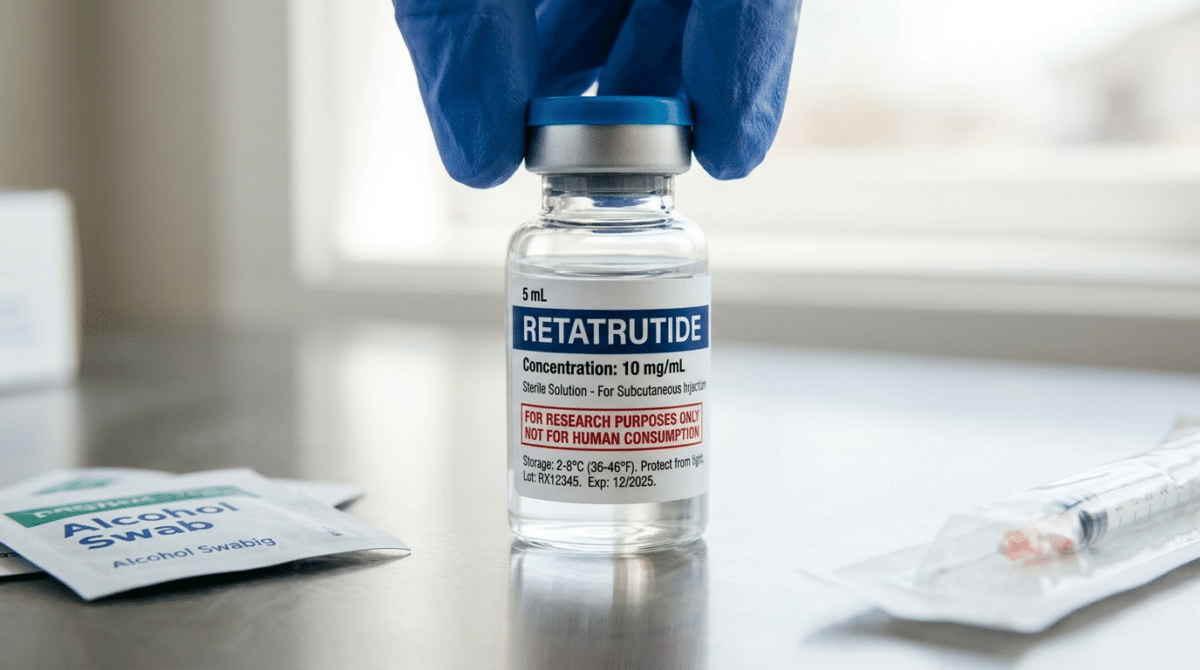
Vendors exploit a legal grey zone by labeling products “not for human consumption” or “for research purposes only.” This language does not protect the buyer — it is a disclaimer acknowledging the product has not been safety-reviewed for human use.
Documented risks of grey-market peptides include:
1. Contamination. The FDA has documented that unregulated GLP-1 peptides seized in the U.S. have contained heavy metals, endotoxins, and bacterial byproducts — dangerous even in small quantities.
2. Incorrect amino acid sequences. Peptide synthesis is technically demanding. A slightly wrong sequence produces a compound with unpredictable receptor binding and side effect profiles.
3. Inaccurate dosing. Without pharmaceutical-grade manufacturing and quality control, the concentration labeled on a vial may be wildly inaccurate — exposing users to underdosing (no effect) or overdosing (severe side effects, hospitalization).
4. Sterility failures. Injectable peptides require sterile manufacturing. Grey-market products sourced from unregulated overseas facilities have no guaranteed sterility — raising real risk of injection site infections, sepsis, and abscess formation.
5. No medical oversight. If something goes wrong, there is no prescribing physician who knows what you took, at what dose, or from what source. Emergency physicians cannot effectively treat an adverse reaction to an unknown compound.
In December 2025, U.S. Customs and Border Protection officers at the Port of Cincinnati intercepted over 5,000 individual shipments of unapproved peptides smuggled from China in a single operation — and the interception rate represents only a fraction of total volume.
Where Is Grey-Market Retatrutide Coming From?
Virtually all retatrutide sold outside official clinical trials originates from Chinese pharmaceutical manufacturing facilities. The supply chain typically works as follows: Chinese API manufacturers synthesize peptide compounds at industrial scale, these are shipped to U.S. and European distributors mislabeled as “research chemicals” to evade customs detection, and domestic distributors repackage and sell to consumers through websites, social media, and direct messages.
A ScienceDirect analysis of the international supply of illicit GLP-1-class compounds confirms that most grey-market weight-loss peptides available in the United States trace back to Chinese manufacturing. The December 2025 CBP seizure in Cincinnati illustrated the scale of this trade — over 300 master cartons, each concealing approximately 15 pre-labeled shipments, found to contain unapproved GLP-1-class peptides from China.
Buyers have no way to verify whether the product they receive is actually retatrutide, whether it was synthesized to the correct amino acid sequence, what facility it was manufactured in, or what other compounds it may contain. Paying a premium price does not guarantee a premium product.
Dr. Q’s Take
Retatrutide is a genuinely remarkable pharmacological advance. Its Phase 3 trial results represent the most significant weight-loss efficacy ever observed in an obesity drug. If it receives FDA approval, it will likely transform obesity medicine for patients with serious metabolic disease.
The risks associated with using grey-market retatrutide for cosmetic purposes are categorically different from using FDA-approved semaglutide or tirzepatide under physician supervision. You are injecting an unapproved compound of unknown purity from an unregulated overseas manufacturer, with no physician oversight, no cardiovascular outcomes data, and a rebound weight gain risk that is likely worse than any currently approved medication.
The common selling point used by social media influencers, gym bros, and pseudoscience websites proclaiming that retatrutide spares lean body mass compared to semaglutide and tirzepatide is likely misleading at best. The most important factors for preservation of lean body mass with any weight loss regimen are the rate of weight loss, daily protein intake, and the amount of resistance training the patient is doing. Though retatrutide appeared to show preservation of lean mass in obese patients compared to other GLP-1 medications in one clinical trial, this is not what I am seeing clinically amongst people using it for cosmetic weight loss and without medical supervision. The potency of the medication and the rapid rate of weight loss in patients who are already lean does lead to significant muscle wasting, particularly when the medicine is not titrated appropriately. Retatrutide is also commonly used in gyms as part of a broader “peptide stack,” often combined with growth hormone secretagogues or anabolic steroids. I cover this in detail in Retatrutide in the Gym: Dangers, Muscle Wasting, and Unregulated Use.
For patients with significant obesity and related comorbidities, the risk-benefit calculation may eventually favor retatrutide — under physician care, within a monitored clinical context, after FDA approval. For someone pursuing cosmetic weight loss through an online peptide vendor, the risk-benefit calculation is not favorable by any reasonable medical standard. It is extremely rare to have a patient not achieve their cosmetic weight loss goals using either semaglutide or tirzepatide.
If you are considering weight-loss medication, FDA-approved options — semaglutide and tirzepatide — are available through licensed physicians and telehealth platforms, come with established safety data, and are manufactured under regulatory oversight. They are the appropriate starting point. Tirzepatide is my personal preference as it produces more weight loss with fewer side effects, but both are good and safe options. Experimenting with your health because of what you are seeing on social media or hearing at the gym is reckless and unnecessary in my opinion.
Frequently Asked Questions
Q: Is retatrutide legal to buy in the United States?
Not for human use. Retatrutide is not FDA-approved, meaning it cannot be legally prescribed, dispensed by a pharmacy, or compounded. Products sold online as retatrutide are classified as research chemicals — a designation that offers no consumer protection whatsoever.
Q: How does retatrutide’s weight loss compare to Ozempic or Zepbound?
Substantially higher. Semaglutide produces roughly 15% weight loss; tirzepatide roughly 20–22%; retatrutide has shown 24–30% in Phase 3 trials. However, more weight lost means more weight available to regain when the drug is stopped — and retatrutide’s discontinuation profile has not been studied.
Q: How does retatrutide compare to tirzepatide for muscle loss?
Retatrutide preserves a higher percentage of lean mass than tirzepatide — approximately 75–85% of weight lost is fat on retatrutide vs. 71–75% on tirzepatide. However, because retatrutide produces far greater total weight loss, the absolute pounds of lean mass lost can still exceed tirzepatide. For example, a patient losing 40 lbs on tirzepatide at 27% lean loss loses ~10.8 lbs of muscle; a patient losing 70 lbs on retatrutide at 20% lean loss loses ~14 lbs. No head-to-head body composition trial between the two drugs has been published. Resistance training and adequate protein intake (1.2–1.6g/kg) remain essential on either medication.
Q: Why does retatrutide raise heart rate more than other GLP-1 drugs?
The glucagon receptor component. Glucagon has direct chronotropic (heart-rate-raising) effects. Semaglutide and tirzepatide do not activate glucagon receptors, which is why their heart rate effects are minimal. Retatrutide’s average increase of 6.7 bpm is clinically meaningful, particularly in patients with pre-existing cardiac conditions.
Q: Will I gain all the weight back if I stop retatrutide?
No discontinuation studies have been published for retatrutide as of mid-2026. Based on GLP-1 discontinuation data (roughly 60–66% regain within one year for semaglutide) and the pharmacological reasoning that triple-pathway suppression creates a larger rebound when all three pathways normalize simultaneously, the rebound risk is expected to be at least as high — and potentially higher — than with semaglutide or tirzepatide.
Q: Where can I access retatrutide safely?
Currently only through Eli Lilly’s clinical trials or its newly registered pre-approval expanded access program, both of which require a physician’s involvement. If you are interested in being screened for trial eligibility, speak with your physician or visit ClinicalTrials.gov and search for “retatrutide.”
Q: Where can I book a consultation with a board-certified Obesity Medicine physician to discuss my weight loss options?
You can visit our website and book a free consultation to see if our concierge weight loss program — using FDA-approved semaglutide or tirzepatide — is right for you.
References & Further Reading
- Phase III retatrutide study demonstrates 30% weight loss — The Pharmaceutical Journal
- Lilly’s triple agonist, retatrutide, delivered weight loss of up to 71.2 lbs — Eli Lilly Investor Relations
- Efficacy and safety of retatrutide — PMC Systematic Review and Meta-Analysis (2025)
- Triple–Hormone-Receptor Agonist Retatrutide for Obesity — Phase 2 Trial, NEJM
- Retatrutide — A Game Changer in Obesity Pharmacotherapy — PMC
- Rebound or Retention: A Meta-Analysis of Weight Regain After GLP-1 Discontinuation — PMC
- Effects of retatrutide on body composition in type 2 diabetes — ScienceDirect
- Structural insights into triple agonism at GLP-1R, GIPR, and GCGR — Nature/Cell Discovery
- Cincinnati CBP foils scheme to smuggle over 5,000 unapproved peptides — U.S. Customs and Border Protection
- Made in China: The international supply of illicit weight-loss medicines online — ScienceDirect
- Inside the booming, gray-market world of injectable peptides — The Hill
Ready to Start a Physician-Supervised Weight Loss Program?
At Good Hearts Health, Dr. Mario Quiros provides personalized, board-certified concierge weight loss care using FDA-approved Semaglutide and Tirzepatide therapy. If you are considering weight-loss medication and want to do so safely — with proper medical oversight and monitoring — we are here to help.
Book your free consultation with Good Hearts Health today →
Medically Authored by Dr. Mario Quiros, MD. Board-Certified Emergency Medicine and Obesity Medicine Physician. Owner and Operator of Good Hearts Health.
Disclaimer: This article is for informational purposes only and does not constitute medical advice. Always consult a licensed healthcare provider before starting, stopping, or changing any medication or supplement regimen. Retatrutide is not FDA-approved and should not be used outside of clinical trials.